One Workplace
2025
Designing Strategic Planning Tools for Small, Rural Hospitals
How can small, rural hospital leaders plan for the future when every task, person, and project competes for prioritization?
Small, rural hospitals are anchors of their communities, but the conditions that make them essential also make strategic facility planning nearly impossible. Lean margins, thin staffing, and a flood of data with minimal capacity to interpret it force leaders into reactive decision-making at exactly the moments that require long-range thinking.
The 2025 One Workplace ONEder Grant gave our team eight months to dig into that gap. We spoke with executive leaders at six rural hospitals across the country, mapped the systemic pressures they navigate, and built four lightweight digital prototypes designed to work as force multipliers. Not speculative concepts, but functional tools that help streamline the process of planning for the future.
Our Approach:
Desk and Market Research
Executive Interviews
Synthesis and Opportunity Mapping
Service and Digital Tool Prototyping
Understanding a System Under Pressure
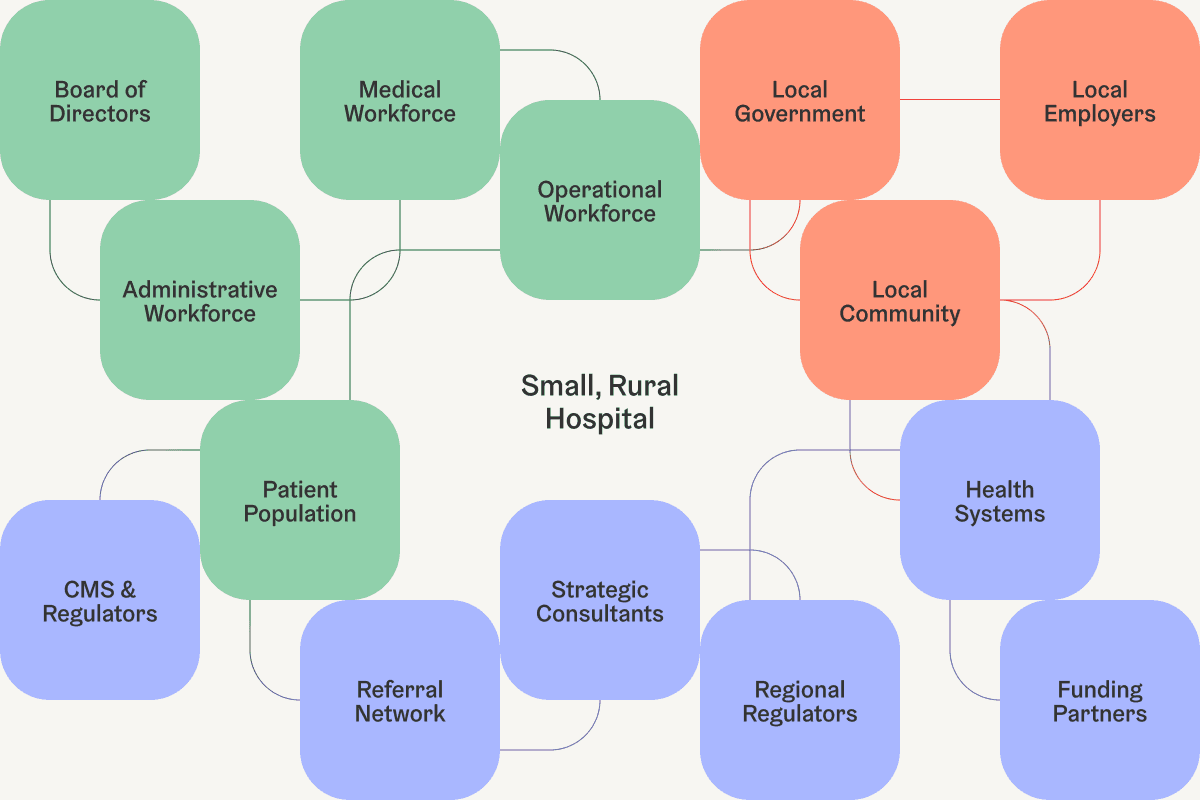
Before talking to anyone, we needed to understand the landscape. Rural hospitals operate inside a tangle of CMS designations (Critical Access, Rural Emergency, Sole Community), each one shaping what a facility can build, bill, and staff. Overlay ownership structures, seismic mandates, and volatile service lines, and the result is a planning environment where every decision has three invisible constraints behind it. Our desk research and market scan mapped that terrain, and confirmed what we suspected: the existing tools for facility strategy are built for large health systems. Small hospitals are often left choosing between consultants they can't afford and platforms that don't fit.
Listening to the People Doing the Work
We interviewed six executive leaders at small, rural hospitals, representing a mix of public and private, nonprofit and for-profit facilities spread across the country. We asked about their planning processes, their pain points, and what would actually help. The quotes that came back were direct: "You have two kinds of data; you have none and then you have the blizzard of too much." "Are there pervasive challenges? Money. Money. It's money." "So much of the decision-making in the C-suite is idiosyncratic based on who's in the team at any given time." What we came to understand is that for leader of a small rural hospitals, stress is all around. It lives in the consistent, daily pressures of running the hospital and pops up in the acute, momentary stressors that arrive when forward planning is undertaken and projects need to be managed.
Four Insights That Framed the Design Brief
We synthesized the research into four insights, each one pointing toward a different kind of tool: leaders are drowning in noise without signal; financial survival crowds out clinical strategy; alignment happens by luck more than process; and daily operations consume the bandwidth future-planning would require. Rather than trying to solve everything, we prioritized three "How might we…" questions that sat at the intersection of highest leverage and what we could actually build in the time we had.
Building Force Multipliers, Not Platforms
From those three questions we developed four prototypes, each one designed to be lightweight, high-value, and usable by an overstretched administrator without a specialist team behind them.
Smart Data Concierge is a conversational AI interface that cleans messy financial and census data, flags errors, and transforms it into planning-ready format. It meets leaders where they are instead of asking them to become analysts.
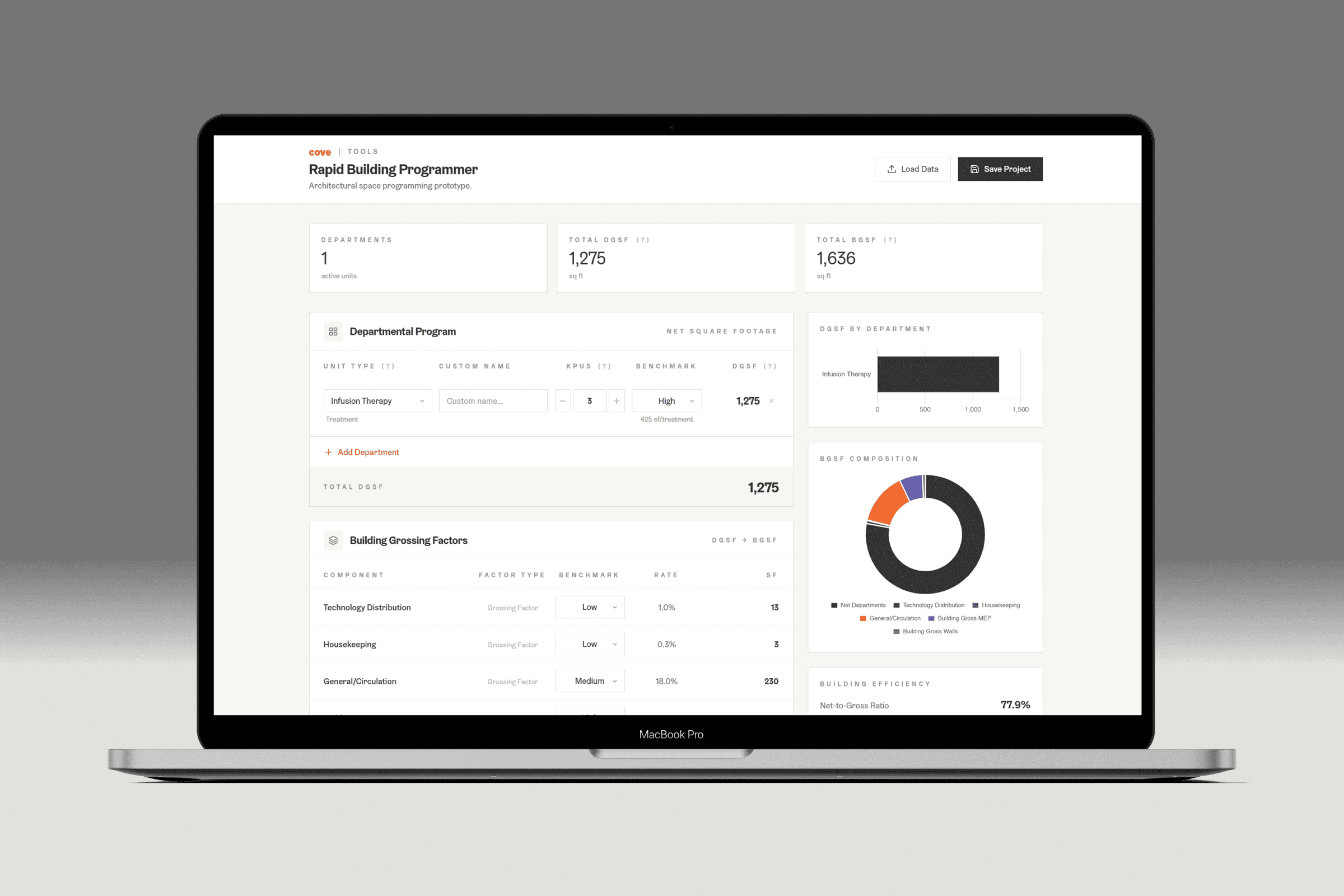
Rapid Building Programmer converts patient demand forecasts into realistic gross square footage estimates, grounded in architectural benchmarks for critical, but often unconsidered spaces such as storage, circulation, etc. This concept helps leaders close the gap between conceptual space requirements and the detailed allocation of space that drive much of a project cost.
Strategic Planning Dashboard is a live, shareable roadmap that functions as a single source of truth. Project status, blockers, budget warnings, and upcoming decisions all live in one place, so alignment becomes a product of process, not personality.
Durable Communications Platform is an automated system that uses a project dictionary to generate consistent board, staff, and community presentations. The same story, told the same way, every time.
Our Impact:
Mapped the strategic facility planning lifecycle for small, rural hospitals across four phases, giving leaders a shared language for work that is often improvised.
Developed four functional prototypes that address specific, high-leverage moments in the planning process rather than attempting a single comprehensive platform.
Established a foundation for the next phase: returning to interview subjects for feedback, refining the tools, and working toward free, fully functional versions for the broader rural hospital community.